

Commercial Roof Replacement in North Charleston: What Facility Managers Should Budget For
If you manage a facility in North Charleston, a warehouse off Palmetto Commerce Parkway, a distribution center in the airport corridor, or a manufacturing building along I-26, a roof replacement is one of the largest capital line items you'll ever put in front of ownership. It's also one of the easiest to get wrong. Budget too low and you're back asking for more money mid-project; budget too late and a hurricane season leak makes the decision for you.
Here's a practical look at what actually drives commercial roof replacement costs in this market, and how to build a number you can defend.
The Five Factors That Drive Your Replacement Cost
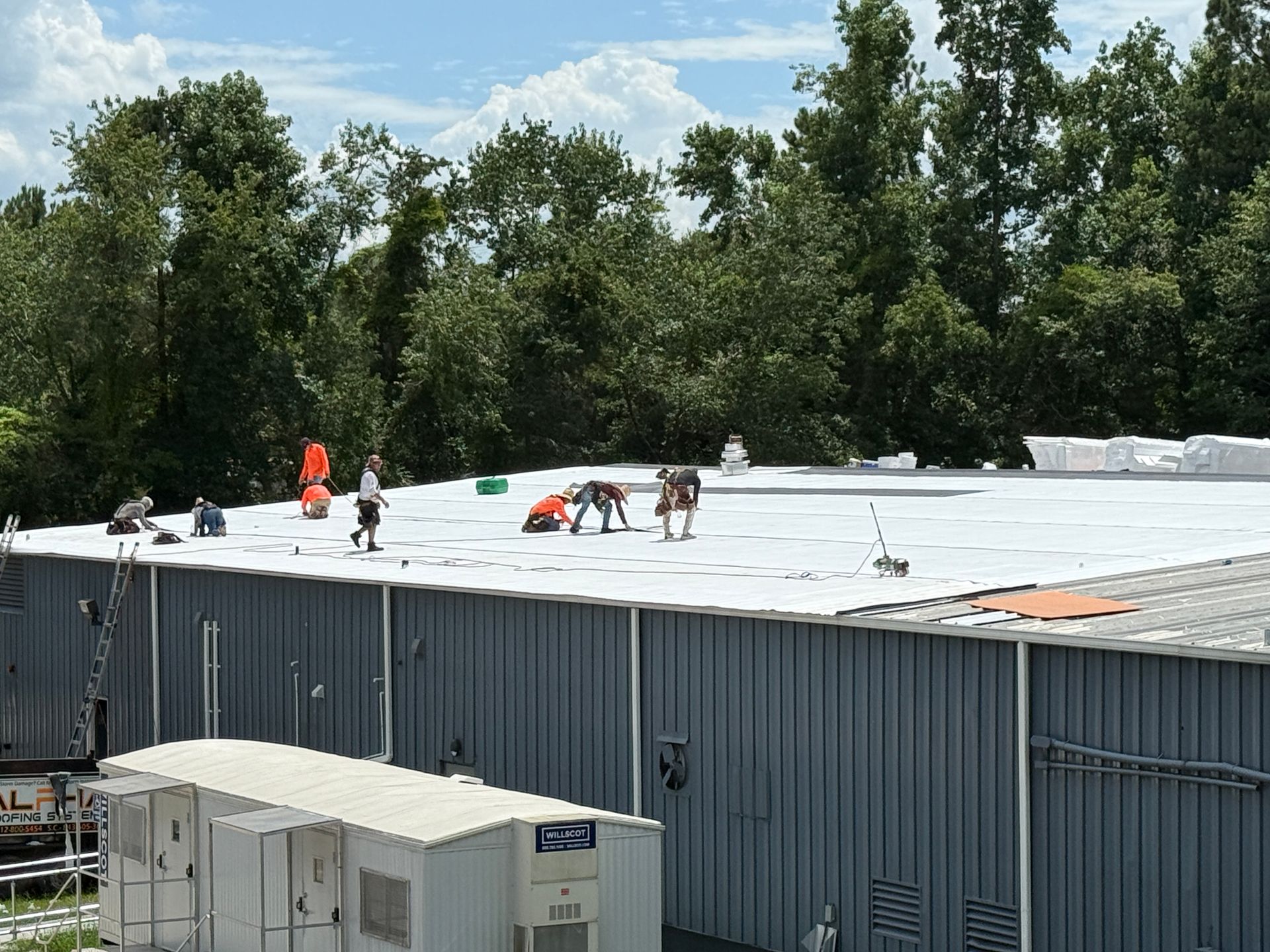
- Roofing system. TPO single-ply membrane is the budget workhorse for the large flat roofs that dominate North Charleston's industrial corridors, lower cost per square foot, faster installation, and a white reflective surface that trims summer cooling loads. Standing seam metal costs meaningfully more up front but delivers 40–50 years of service, roughly twice the lifespan of a membrane system.
- What's under the old roof. Tear-off findings are the most common budget-buster. Saturated insulation, rusted decking, and hidden moisture add cost after the project starts, which is why a thorough pre-bid inspection with core samples is worth insisting on.
- Coastal wind code. Charleston County sits in a high-wind zone, and current wind-uplift standards dictate fastening density, edge metal, and attachment methods. Replacing a roof installed under older code often means upgrading to today's requirements, a real cost, but also real protection when a named storm arrives.
- Access and logistics. A roof over an active loading dock is a different project than a roof over an empty building. Crane placement, material staging, security requirements, and working around truck traffic all shape labor hours, especially at port-related and airport-corridor facilities.
- Rooftop equipment. HVAC units, gas lines, conduit, and curbs all need to be flashed, raised, or temporarily disconnected. The more congested the roof, the more detail work in the budget.
Budget on Lifecycle Cost, Not Sticker Price
The cheapest bid is rarely the cheapest roof. A facility manager comparing options should divide total installed cost by expected service life, then factor energy impact and maintenance. A TPO system with a lower installed price may cost more per year of service than a metal roof that outlives it by decades or the reverse, if ownership plans to sell the building within ten years. The honest answer depends on your hold period, your operations, and your building, which is why we walk facility teams through both numbers rather than pushing one system.
One more line item worth adding: a preventive maintenance program. Scheduled inspections and minor repairs typically cost a small fraction of one emergency repair and give you the documented roof history that supports insurance claims and warranty coverage.
The Restoration Question: When You Don't Need Full Replacement
Before you budget a full replacement, ask whether the roof is a restoration candidate. If the membrane or metal is aging but the insulation below is dry and the structure is sound, a restoration coating can add 10–15 years at a significantly lower cost than replacement, often while keeping the project classified as maintenance rather than capital expense. Not every roof qualifies, and a coating over a wet roof is money wasted, so the answer starts with a core-sample inspection, not a sales pitch.
Timing Your Project Around Hurricane Season
In North Charleston, when you replace matters almost as much as what you install. The ideal windows are late fall through spring, after hurricane season and before the daily summer thunderstorm pattern sets in. Budget approval in Q4 or Q1 positions you for the best scheduling, full material availability, and a roof that's at current wind code before the next storm season starts. Waiting until a June leak forces the decision puts you in the busiest, wettest, most expensive part of the calendar.
Get a Real Number for Your Building
Generic per-square-foot figures are a starting point, not a budget. The only defensible number comes from your actual roof, its system, its condition, its access, and its code requirements. As a commercial roofing contractor in North Charleston, SC, Alpha Roofing Services provides free on-site assessments with core sampling, photo documentation, and a written estimate with options at more than one price point, the kind of document you can take straight to ownership.
Call 843-548-4032 to schedule your assessment, and if storm damage can't wait for a budget cycle, our emergency roofing team in North Charleston responds 24/7.